Tuesday, July 31, 2012

Yale Fellowship Day #1: Earth Science Animation Resources and Using Science Notebooks Resources

So, kids, here I am at Yale University with the Planetarium Director and Education and Astronomy people.
I am going to post for you some (or as many as I can) of the resources we are using:

http://astro.unl.edu/classaction/ 

  1. Okay, on this one, scroll down.  
  2. If you click on "Coordinates and Motions", and (let it load). 
  3. On the Splash Page, click on "Animations" at the bottom of the page.
  4. It gives you TONS of astronomy animations that address the question, "What are the reasons for the seasons".

This is a BETA site...I don't think you can Google it.  So this one's probably new for all of you!
Try clicking "Visualizations" under #3.

___________________________
Lecture: Christopher Stone    "A Science Notebook Primer"
Notes:

--a tool in your toolbelt for improving student accountablility and achievement
--using them to inform your instruction (formative assessment)
--engaging students in meaningful "conversation" about science topics (Fulton/Campbell are researchers on how this works to improved learning)

Click this link for a file of articles (ideas, rubrics, worksheets, etc.) from science education publications on the topic.


Share/Bookmark

Friday, July 27, 2012

Teaching Debate with Hydraulic Fracturing or Fracking

I recently received a comment (that I did not post on my blog) about my recent post that was entitled "Teaching Earth Science and Hydraulic Fracturing". The comment read "Do you teach your students to look at both sides of an issue?" and provided a link to a rebuttal "movie" to the Gasland film. I didn't watch the rebuttal.

I never click on links that I'm not sure of, and I sure as heck don't post comments from anonymous people on my blog. If you have a comment worthwhile to post, you have an identity, or at the very least a profile that would allow contacting you for intelligent dialogue.  I love debates!

If you'd like to have a debate in your class on hydraulic fracturing, try this fantastic point/counterpoint article "Should Fracking Stop?:   Extracting gas from shale increases the availability of this resource, but the health and environmental risks may be too high.   It was published in the peer-reviewed journal "Nature".  It is a good guideline for concepts, ideas, good science and a bibliography of resources for older students.

I'll answer that question anyway. "Do I teach my students to look at both sides of an issue?". Yes, I do. Teaching students to absorb facts without encouraging and nurturing their critical thinking skills is useless and can be downright harmful--especially in the age of the Internet, the tabloid press and political ads.

I do not teach "anti-natural gas harvest" rhetoric. Educational studies have shown that when a teacher uses the kind of teaching techniques that would allow heavy inserting of his/her own ideals into discussion that it inhibits critical thinking (Kimbrough, 2007; Oliver and Lalik, 2004).  This is not good teaching.

Harvesting our country's natural resources and being ecologically responsible are not mutually exclusive activities. 

It is exactly that mindset that has politicized environmental care and stewardship from the start. There is nothing political about it. Humans will not survive if we carpet-bomb the atmosphere and poison our water sources.  So I encourage my students, their parents, my friends and family and my readers (that's you) to contact their congresspeople and tell them what they think of it all.

I am a scientist and a teacher.  I teach my students to look at all available (reliable) data and then to come up with solutions, ideas, causes and relationships and then to test again.  I also teach them that ANYTHING is possible.  Even hydraulic fracturing without chemicals that destroy aquifers and make residential and farmlands uninhabitable.



Share/Bookmark

Friday, July 13, 2012

Teaching Earth Science and Hydraulic Fracturing (Fracking) Awareness

Today, I was writing curriculum for my Earth Science class.  I wanted to include some current news and issue to study about how humans are living with and/or affecting geologic events.  My focus was primarily on the earthquakes that can be associated with hydraulic fracturing techniques used to recover natural gas from shale deposits.  What the frack?  I was very disturbed by the reading and research that I did.  I guess I am wondering why it is totally necessary for the drilling companies to use hundreds of thousands of gallons of poison mixed with water for the drilling?

Most disturbing finding:  that in 2005, Congress passed legislation making hydraulic fracturing companies exempt from many key regulations in the Clean Air Act and the Clean Water Act?  I immediately made some calls to all of my congressmen about regulating the pollution created.

Regardless of my own personal convictions, as a science teacher, I believe it is my responsibility to present a current scientific controversy and teach students to think critically about it.  This means thinking about it from both sides and coming to a conclusion on your own.  This fantastic article called "Should Fracking Stop?" that was published in the peer reviewed journal Nature provides source-cited point and counterpoint.

"Extracting gas from shale increases 
the availability of this resource,
but the health and environmental risks may be too high."


Share/Bookmark

Thursday, July 5, 2012

Spectacular Sunset Effects in Manhattan on July 11 & 12, 2012

Sunset in New York City on July 11 & 12, 2012 will be spectacular!  The sunset on these days are aligned perfectly with the grid of streets and buildings in Manhattan giving photo-opportunities that are worthy of museum walls!

This is a photo that Neil deGrasse Tyson (the planetarium director at the Hayden Planetarium) took in 2001: 


Tyson has dubbed the effect: "Manhattanhenge", likening it to the solar observatory effects (lining up on the solstices) of the ancient stone circle Stonehenge on Salisbury Plain in England.  For more details, click here.
On the 12th of July you will see a half-sun: half above the horizon and half below at 8:25 PM.  On the 11th of July you can see the full disk of the sun at 8:24 PM.  However, you should definitely find your viewing spot a little earlier. so you can watch it come into view.

There is a special presentation on July 11 at the planetarium that will be followed by a live viewing of Manhattanhenge outside the museum.

Viewing suggestions from the AMNH website:
 "For best effect, position yourself as far east in Manhattan as possible. But ensure that when you look west across the avenues you can still see New Jersey. Clear cross streets include 14th, 23rd, 34th. 42nd, 57th, and several streets adjacent to them. The Empire State building and the Chrysler building render 34th street and 42nd streets especially striking vistas."


Share/Bookmark

Wednesday, July 4, 2012

What a great way to celebrate my 30,000th hit!

That was just so supremely cool! After one day, and just a couple of handfuls of ad clicks, we just raised enough to send $35.12 to Heifer Project International. It's enough to donate TWO flocks of chicks to families with children-- This will change their lives for generations and change the lives of the people in their community! Read how it works: "In Tanzania, Omari and Kulwa were struggling to raise a family on just 50 cents a day. With the training and chicks they received from Heifer, egg sales have boosted their daily income to $2, so they can now buy food and still pay school fees. Now, through passing on the gift, all of the children in their village are going to school." Thank you so much for making this happen! I'll post an update when I get the donation confirmation
Share/Bookmark

Monday, July 2, 2012

2 more clicks=4 more dollars!

We're at 9 dollars and counting!  Keep clicking on those ads!
Share/Bookmark

Three hours, 20 pageviews and 2 ad clicks=$4.27

If we can keep this up, in less than a WEEK we'll have more than $500 which is enough to donate an entire heifer to a family.  AMAZING!  Let's go team!  Keep clicking on those ads!  I know the ad clicks generate way more revenue than the pageviews so don't forget to do that if you really want to make the most of your time.
Share/Bookmark

Experiment: let's see how much money we can get from clicking ads on my blog and send it to Heifer International

Click Away on those ads, People!  Let's click our way to a whole cow!

So, on the eve of my 30,000th lifetime blog hit, I wanted to do something special.  Let's donate to charity!  Here's how we're going to do it:  I sent out links on my Google+ feed and my LinkedIn feed (I don't have a Twitter feed, but feel free to tweet this) about getting the 128 more pageviews it will take to get me over 30,000.  I get nothing from the transaction but satisfaction of hitting a numerical milestone.

So, I checked my AdSense account.  I was going to remove the ads, because let's face it, I thought.  I'll probably never get a check from them.  THEN IT HIT ME:  Leave the ads.  In fact, let's put MORE of them in there.  Then, send a message to the universe that any AdSense check I get (I've never gotten one--I don't even really know how it works) will go straight to my favorite charity:  Heifer Project International.  

My goal is to be able to donate a Heifer, but maybe that is too modest a goal for such an amazing community.  I'll post on my AdSense account progress as you guys click like crazy on the ads...you just never know...


Share/Bookmark

Thursday, June 21, 2012

Broken Wine Glasses? Don't Fret; Model Gravitational Lensing, Instead!

Today, I purchased two very expensive crystal wine glasses to replace ones that I have broken.  On the way home, I broke them.  Accidentally.  Not to worry!  Now I can use the bases as very expensive crystal "gravitational lens" modeling tools.

In  this TED Ed video that I saw (amaaaaaaaaaaaaaaaaaaazing), physicist Patricia Burchat explains dark energy and dark matter in such a fascinating and interesting way.  I would love to have her as my physics professor.  In the video, she explains and demonstrates the use of a wine glass bases as a "gravitational lens" that bends space/time and light.
Watch it!  So good. 


Share/Bookmark

Meaningful Work

One of my favorite things each year at my amazing school is that I get to give a speech at our 8th year graduation.  It is a very moving ceremony each year, because many of our graduates have been in the school since they were very, very young--some as young as two years old!  Last year, the theme of my speech was Believe Impossible Things, but this year I took a different tone:


Meaningful Work
by Rebecca Kaplan

Good evening, everyone!  I am happy to see you all here tonight.  The theme of my speech this evening is one that is very dear to all Montessorians.  It is entitled, “Meaningful Work”.  I read a book this year called Outliers, by Malcolm Gladwell.  It was absolutely fascinating, I couldn’t put it down.  It is an amazing work of nonfiction that discusses the relationship between opportunity and meaningful work in the context of some of the most interesting people in our country.  Has anyone in here read this book?  Well, if you haven’t, I highly recommend it.  Malcolm talks at length about the meaningful work that we all are looking for and this is what he says about it:

“Those three things--autonomy, complexity, and a connection between effort and reward--are, most people agree, the three qualities that work has to have if it is to be satisfying.  Whether or not our work is fulfilling is what ultimately makes us happy.  Being a teacher is meaningful. Being a physician is meaningful.  Hard work is a prison sentence only if it does not have meaning.  Once it does, it becomes the kind of thing that makes you grab [your family} and dance a jig.” (p.149)

When you feel the way I do about the universe--the way it is put together and the way it is expanding and unfolding--you can see that it is easy for me to love being a science teacher and to find my work meaningful.  And if you look at this fantastic group of students sitting up here on the dais you can understand how much more rewarding and meaningful my work has been for me over the past two years.

I would like to extend my sincerest and most profound gratitude to each student and to their parents.  I have had the chance to be their science teacher, SSAT coach, lunch server, recess supervisor, student advisor and “professional expert project consultant” and I have enjoyed every minute.  The two years I have spent with these young men and women are two of the most extraordinary years in my career.

Never before have I been given the opportunity to spend as much time with my students as I have with you--getting to know you, laughing with you and learning how you learn best.  How rewarding it has been to be met with such willing dedication, passionate enthusiasm, tenacious hard work and above all, exuberant good humor.  We have done a lot of hard work, but we have also had a lot of fun.

Some of our work over the past two years includes:
  • Discovering Newton’s Laws, or “rolling lots of marbles down a track”.
  • Learning the foundations of experimental design, aka “making coke and mentos fountains”.
  • The principles of rocket science, affectionately referred to as “blowing stuff up”.
  • Exploring phase changes in matter, or “making ice cream in a bag”.
  • Discovering chemical and physical changes, which I like to refer to as “lighting things on fire”.
  • Learning the relationship between astronomy and cartography in navigation, or “getting lost in the athletic field (which is flat and has no trees) even though you had a compass and directions”.
  • Modeling the layers of the earth (playing with clay and playdough).
  • Using solar observations and models to prove the direction of the rotation of the earth, or “drawing with chalk all over the parking lot”.
  • Experimenting to examine a heating curve of H2O, affectionately nicknamed by the students as the “watching grass grow” lab.
  • Last and most: the extraordinary Expert Project.

The Expert Project was a complex independent study project that was hard work that came with an exciting and satisfying payoff at the end.  So, “Expert” and all of these other works that I have just told you about have in common the very qualities of meaningful work that Malcolm Gladwell was talking about in his book.   You can tell when you are doing meaningful work--it always has that same feeling: it’s hard work, but it’s easier somehow.  It is satisfying.  In fact, many times it also feels exhilarating.

Think back, everyone (graduates, parents, students and teachers): think back to some of your most fulfilling work at Fraser Woods Montessori.  It was independent and autonomous.  It was complex and difficult.  Above all, however, it was satisfying and rewarding.

My advice to our graduates is:
Remember that rewards of meaningful work are infinite--it pays you back with as much as you put in.  Reap the unlimited rewards that life has to offer you by finding your meaningful work and throwing yourself into it.

The philosopher Theodore Geisel commented wisely on the rewards of finding your own meaningful work.  Do you know who Theodore Geisel is?  Dr. Seuss!  He said:

“You have brains in your head.
You have feet in your shoes
You can steer yourself
any direction you choose.
You're on your own.  And you know what you know.
And YOU are the guy who'll decide where to go.

You'll look up and down streets.  Look 'em over with care.
About some you will say, ‘I don't choose to go there.’
With your head full of brains and your shoes full of feet,
you're too smart to go down any not-so-good street.

And you may not find any
you'll want to go down.
In that case, of course,
you'll head straight out of town.

It's opener there
in the wide open air.

Out there things can happen
and frequently do
to people as brainy
and footsy as you.

And when things start to happen,
don't worry.  Don't stew.
Just go right along.
You'll start happening too.

Congratulations!
Today is your day.
You're off to Great Places!
You're off and away!”

Exerpted from Oh The Places You’ll Go, by Dr. Seuss

I love you all, 8th years!  Good luck!

Share/Bookmark

Wednesday, May 16, 2012

Win! Yale-Peabody Summer Astronomy Fellowship!

EPIC WIN!
I get to spend three days with the telescopes and planetarium at the Yale University Leitner Observatory.  "Excited" doesn't even come close to describing how I feel about this.  

It also comes with some perks: free money, plus a membership to the Yale-Peabody Museum (the original dinosaurs, people) multiple field trips with bus costs, planetarium shows and museum admission covered for all of my classes.  But that's, like, not even the best part.  

TELESCOPES.  Have you seen their telescopes?  Yes!  I am especially interested in learning how to build a scope/viewer that will let me and my students observe sunspots (and future eclipses).  I have no idea if they will teach me how to do it, but I'm going to ask.  


Share/Bookmark

TED-Ed Cricket Beat Box. TED Talk Tuesdays just got a boost.

I do this thing in my science class called "TED Talk Tuesdays" where we watch TED talks that I've previewed or that students have recommended.  Then, we talk about them.  It's way more fun than science current events from the newspaper.

The newest one I've seen is from the new-ish? TED-Ed series.  Science teachers, take note!


Share/Bookmark

Sunday, February 19, 2012

Science Vacations With Kids in Baltimore and DC

Okay!  So what does a science teacher do with her own children when on vacation?  I take them to fabulous science museums all over the country!  On the docket for this vacation:  a trip down to Baltimore and Washington DC.  Amtrak is having a deal on companion tickets to Baltimore: save 30%.  It's a pretty good deal and the kids love the train.

Why Baltimore? you ask.  The most amazing aquarium I've ever been to!  The Baltimore National Aquarium on the Inner Harbor in Baltimore.  When you get to the site, click Plan Your Visit>Discounts and Promotions to find deals on the tickets, which are pricey.

 I usually buy my tickets for everything a la carte, but you can find some packages for hotel, meals, and VIP admission to the aquarium right here at the Visit Baltimore Harbor Magic Site.  

Other destinations: the new science museum in Baltimore: The Maryland Science Center.  This museum is also right on the water in the Inner Harbor.  I booked my hotel on Priceline, and it allows you to select the Inner Harbor location.  

I haven't been inside YET, but I was in Baltimore in December and went for a walk around the beautiful harbor.  There was a long line outside the museum waiting for it to open on a sunny Sunday.  Both the Aquarium and the Science Center have incredible deals on Friday nights!  Starting at 5pm, they sell tickets for full admission for $8.  Amazing!  You can add on additional activities (like IMAX movies, 4-D theater, dolphin shows, etc.) for a small fee.

There are so many cool places to go with kids in Baltimore's Inner Harbor! But those are the two places I will take my kids in March.  

The next day, I have friends who live in DC, so we're staying with them and then going to the FREE museums there:  

The National Air and Space Museum is first on the list:  it's a classic!  I remember seeing my first IMAX film here in 1982...it was amazing!  The Space Shuttle Discovery is arriving there in April, so we'll be too early for that. 


Then, my older son is insisting on seeing the Hope Diamond at The Smithsonian National Museum of Natural History.  The best part is: we can go in and see the diamond and leave for lunch without worrying about admission:  the admission to the DC museums is free!


Share/Bookmark

Wednesday, February 8, 2012

Free Study Tool! iPad Smartcover App: Evernote Peek


This is absolutely adorable.  About 20% of my students have iPads...they are going to LOVE this!  It's free in the Apple App Store.  Click here!
Share/Bookmark

Science Project Timeline

I have been running science fairs successfully with my students for 12 years now.  For new teachers, managing a project of this size and scope can seem daunting.  Why not just copy what I've got so far and make changes where you'd like to make them?

This link will take you to my 6th and 7th grade Project Timeline, which has worksheets, guidelines and rubrics attached for most of the items that are to be submitted.  Let me know which work best for you...if you'd like me to post something in particular, drop me a comment!
Share/Bookmark

Friday, February 3, 2012

Edible Science Model Project: Part 4: Periodic Table of the Cupcakes!

Here we are, folks!  The Periodic Table of Cupcakes was a phenomenal success--thank goodness for 90 minute lab block periods...

We had a TON of extra cupcakes.  So, after all of the classes in the school had an opportunity to see the Table of Cupcakes, we sent representatives to the Lower Elementary School classrooms to explain what they were and to share them.  The younger kids got a real kick out of "eating Plutonium" or "eating arsenic".


...too bad you can't taste them from there, the homemade marshmallow fondant was incredibly tasty.  Click here to view the inspiration for the project and the link for the recipe for the fondant.  Keep in mind--it's so easy a 7th grader can make it (a Very Smart 7th grader).

More Edible Science Model Project Posts...

1. Jello Cells
2. Cell Cakes

Got more edible Science Projects?  Contact me for a guest posting on my blog!
Share/Bookmark

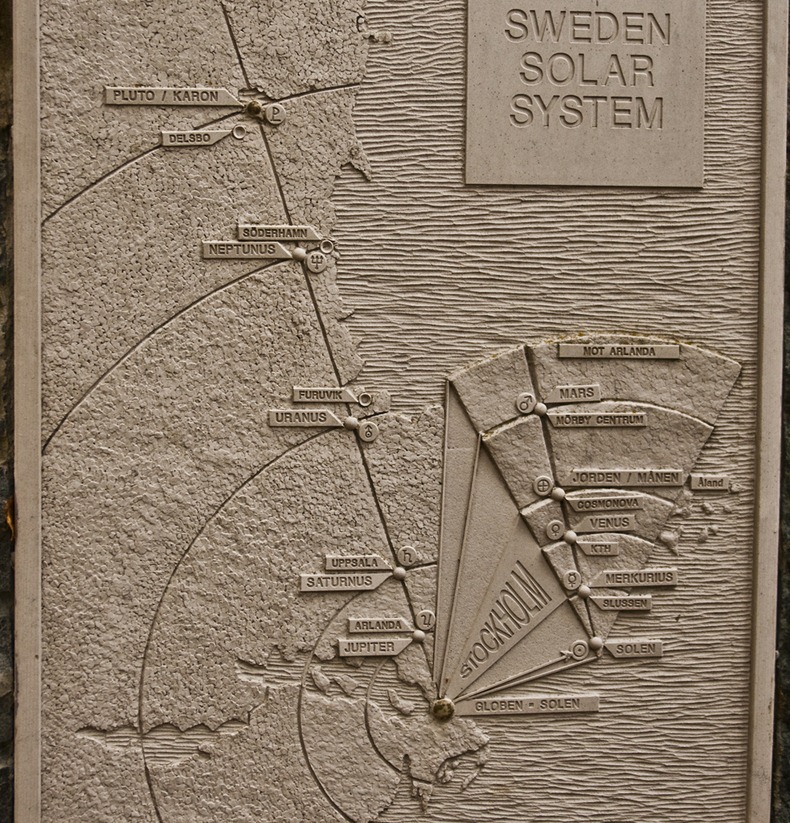
Modeling the Scale of the Solar System? Try THIS one on for Size--It Covers the Entire Country of Sweden!

Many teachers of astronomy begin with activities or projects that help students to grasp the enormous scale of the solar system--which is a good idea, because all of the diagrams we see in textbook give us the poorest sense of it.  (See this post for more information on that...)


However, here's the biggest one on our planet--in Sweden.  It begins with the Sun (the Ericsson Globe) in Stockholm--modeled at 110 m in diameter and ends at the Terminal Shock.  The Terminal Shock (the edge of the heliosphere) in the Swedish model is 950 km away from Stockholm!


Share/Bookmark

Friday, January 27, 2012

Educational Rap: Rhythm, Rhyme, Results has excellent new science songs!

They have SMASHING new songs--The Planets and The Periodic Table of the Elements.  My students request the songs regularly.  By  most accounts, they preferred The Planets right away; some students now are finding that they like the Periodic Table better, but maybe just because that is what we are studying.

Click here to view the lyrics, listen to samples of the songs and/or purchase the music.  Today only, you can download a FREE song on the Civil Rights Movement.


Share/Bookmark

Edible Science Model Projects: Part 3--The Periodic Table of Cupcakes!

Our success with the Cell Cakes in 6th year science inspired our 7th years to create the Periodic Table of the Cupcakes which will be occurring next week on Wednesday.  Maybe I'll ask Daria Musk to join us in a hangout of the creation!?   That would be really fun.  I will post photos and a student-edited video when we are done.

Instead of using icing for the writing, we are going to use edible cake pens (found here) and we are making our own Marshmallow Fondant.  Why the extra work?  The pre-made fondant that you can purchase tastes not-great, and by all accounts this easy recipe makes delectable fondant that you actually enjoy eating, instead of peeling it off the cake (like an orange rind) and then eating it.

Why fondant?  Because then we can pre-make the atomic symbol:  we can write out the symbol and the atomic number (and mass if we have the space) and then form an assembly line of sorts to put it all together. Theoretically.  We'll see.

Anyway, here's the YouTube video that inspired us and the Huffington Post article that describes the video.


Share/Bookmark

Edible Science Model Projects: Part 2--Cell Cakes!


So this year, we made Cell Cakes instead of Jello Cells.
This is a project that you don't have to encourage the kids with--they want to spend all of their time discussing, planning and creating it.  They seem to have an inexhaustible supply of energy for learning about cell anatomy when they are going to be able to eat it!

The criteria for these cakes were:

  1. Must contain all of the structures that were on the worksheet that I handed to them: (nucleus, golgi body, ER, rough ER, ribosomes, vacuoles, mitochondria, cell membrane and cell wall for plants) 
  2. Must contain a minimum of three additional structures (this requires independent research)
  3. Labels are clear and legible
  4. Each structure is easily discernible from the others and looks as much like the real thing as is practicable.
The advantage of the Cell Cake over the Jello Cell:
  • less messy 
  • no heating required
  • the cakes can be baked at home and brought to school
  • more attractive and tastier product
Disadvantage:
  • looks (usually) exactly like the diagrams in the text and online, so students don't get a sense of how all cells look slightly different--the ziploc bag animal Jello Cells took care of that.
  • no opportunity for sectioning lessons, which was a MAJOR disadvantage


Share/Bookmark