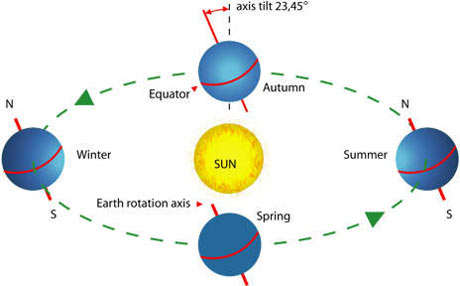
My last post on teaching the reason for the seasons in middle school focused on the biggest misconception of most people when it comes to the concept, and an excellent curricular resource that I have successfully used for years to help teach this concept that is difficult to teach. It is difficult to teach mainly because of the misconceptions that many people (including very smart people--some of them are teachers!).
I didn't even talk about the ACTUAL reasons--I spent all of my time on UNTEACHING a misconception, which is one of the challenges of being a science teacher! Kids come to us with all sorts of ideas about how the world works, and we have to ensure experiences that help them understand what is right about their models and what ideas need, ahem, "reworking". So here they are:
Here is a summary of the reasons for the seasons:
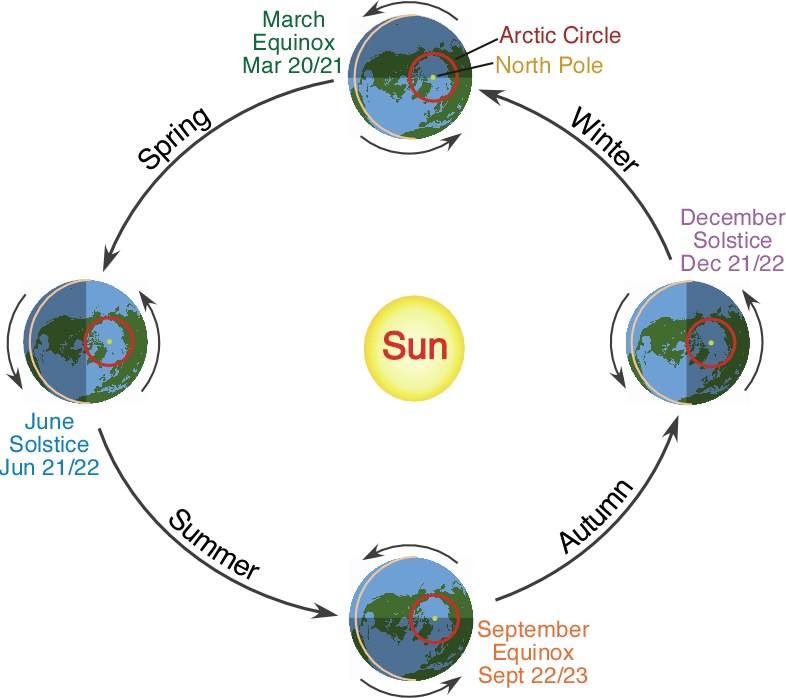 |
| Images from http://www.physicalgeography.net/fundamentals/6h.html |
1. The big, overarching, reason for the seasons is that the Earth is tilted 23.5 degrees from vertical on its rotational axis; and the Earth revolves around the Sun with the axis always pointing in the same "direction" in space. This results in several phenomena:
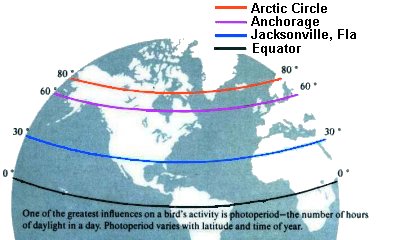
- The number of daylight hours a region receives varies based on latitude and season. If the Earth were not tilted, it would be like an equinox every day: 12 hours of sunlight and 12 hours of darkness. In the northern hemisphere, in summer, Connecticut gets around 15 hours of daylight each day and 9 hours of darkness. As you move north in latitude, the number of daylight hours in summer increases, so Anchorage, Alaska would get 19 hours of daylight on the same day that Jacksonville, Florida gets 14.
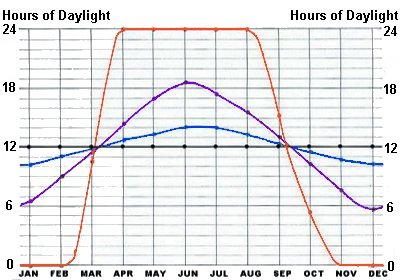 |
| http://www.paulnoll.com/Oregon/Birds/climate-photoperiod.html |
- When there is daylight on a part of the Earth it warms up. When there is darkness, it cools off. In the summer, New England warms up for 15 hours or so and then cools off for 9 hours. It warms for longer than it cools...this happens day after day after day so there is an overall warming effect. In the winter, the opposite happens: there are many more hours of cooling time--15 hours of darkness--than warming time (9 hours) and day after day, this results in a cooling effect.
2. The other reason for the seasons is that the Earth is a sphere and so the solar intensity per unit of surface area differs based on latitude and time of year. If daylight hours were the only thing that determined the average temperature at a certain latitude, then areas above the Arctic Circle would be the hottest places on Earth in Northern Summer, because it receives 24 hours of daylight (see chart above). So, there has to be some other factor at work here: many equatorial regions only have two seasons--hot and wet or hot and dry! It's always hotter there than at the poles. The solution is solar intensity per unit of area which changes based on the angular height of the sun.
- Angular height of the Sun in the sky changes throughout the day, with the Sun at it's highest point at solar noon; it also changes throughout the year, as shown in these diagrams:
 |
| Angular height of the Sun at 40 degrees Northern Latitude at different times of the year. |
 |
| http://www.extension.org/pages/62239/identify-sun-and-shade-areas-in-the-landscape |
- Solar intensity changes in proportion with angular height. A great activity to do with students is using a flashlight held at constant height over a piece of graph paper. Trace the outline of the circle of light and then tilt the flashlight slightly. The new shape is an oval with a much larger surface area (count and compare the squares) over which the same amount of light is spread. So the solar intensity per unit of area in the image to the right is much less.

Now my post is too long, and I have to teach a class in 5 minutes!